
Kubernetes
auf einem Blatt.
Dichte Referenz für Senior Platform Engineers und SREs. Workloads, Networking, Storage, Security, Scheduling, Autoscaling, Diagnose und Anti-Patterns. Keine Einsteiger-Folien.
Vorschau (2 Seiten A4 quer + Brand-Rückseite)
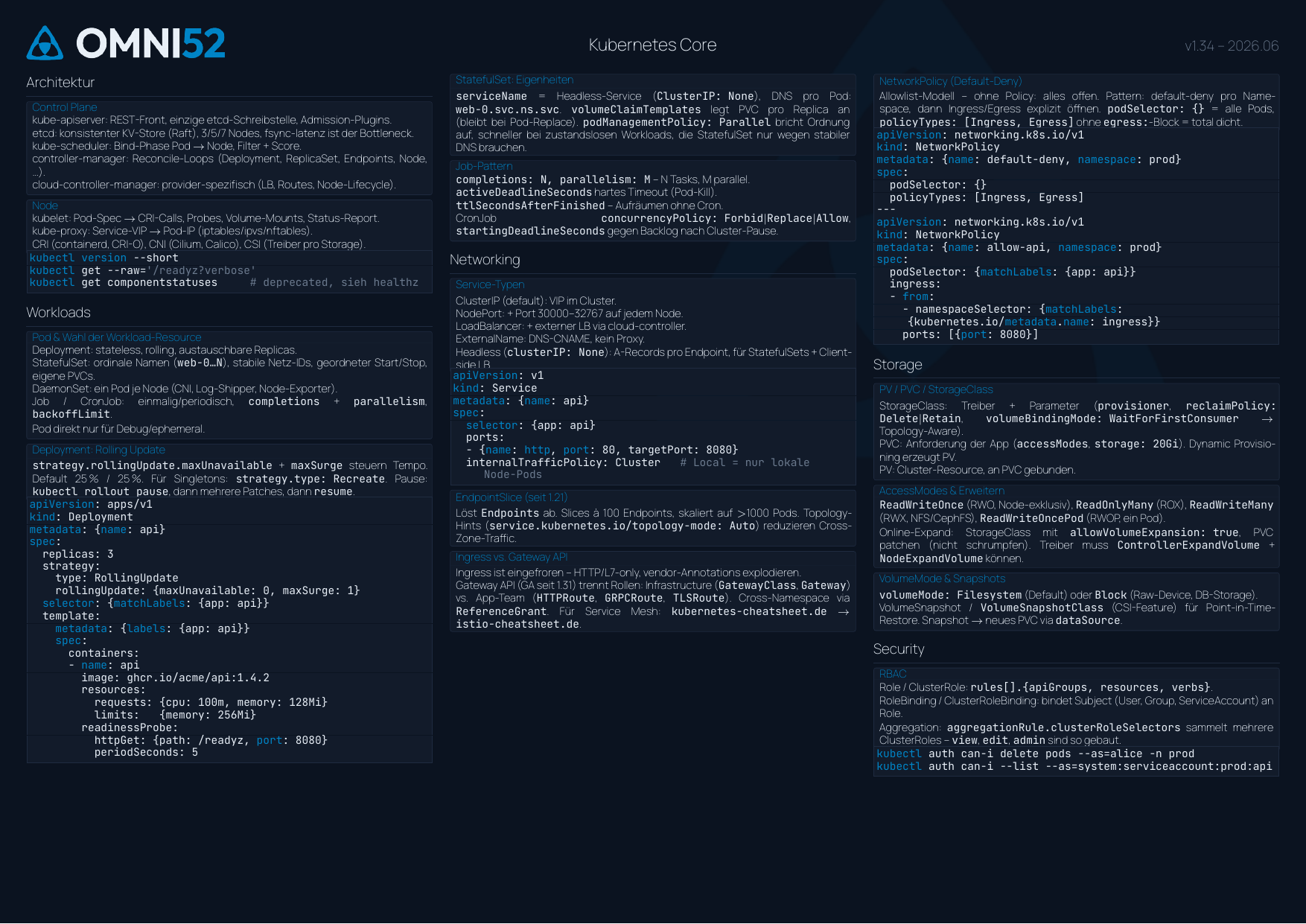
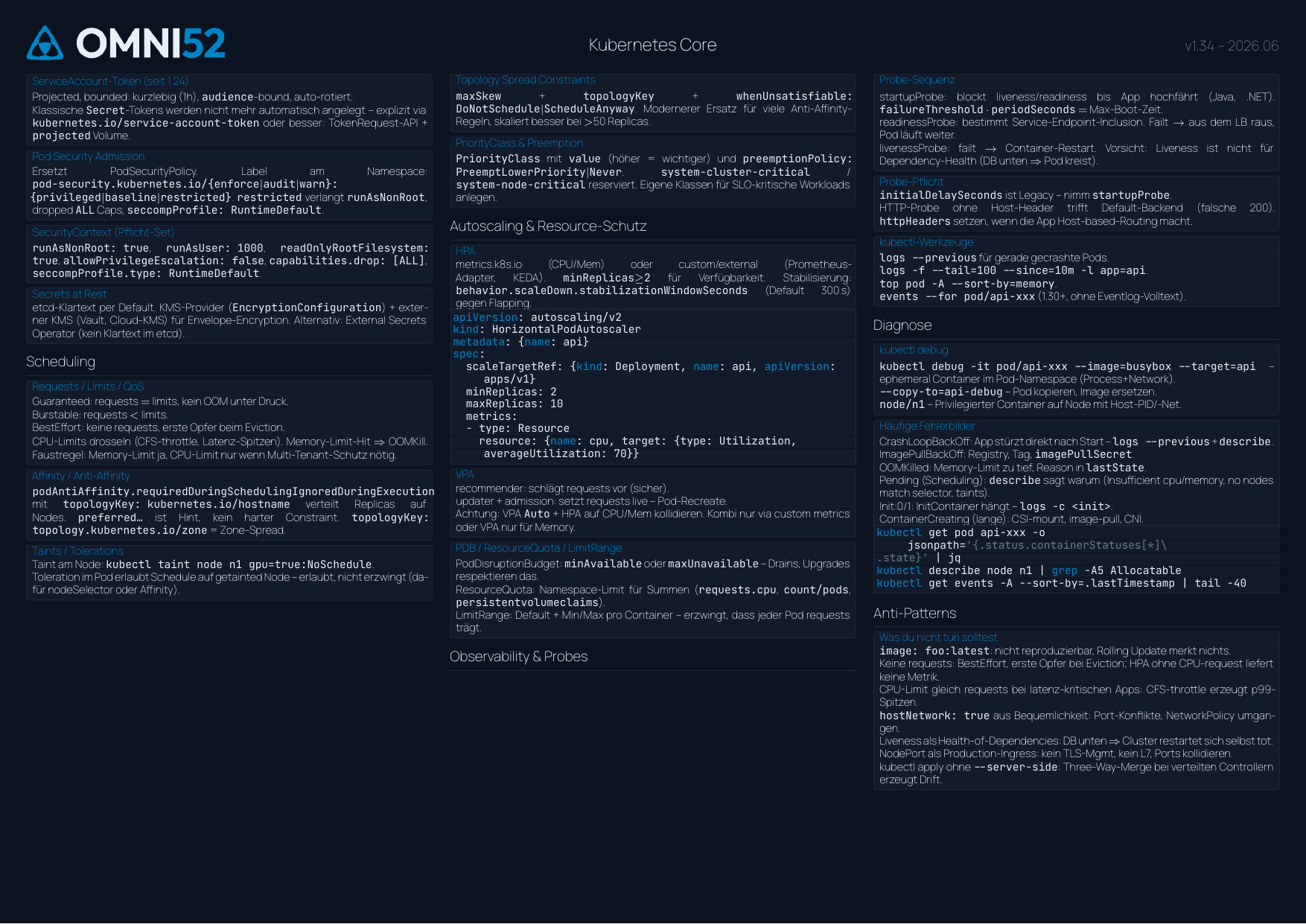
PDF herunterladen
Direkter Download, keine Mail-Adresse nötig. CC BY-SA 4.0 , kopieren, drucken, weiterverteilen ist ausdrücklich erlaubt, solange die Quellenangabe sichtbar bleibt.
Was drin steht
Workloads
Pod, Deployment, StatefulSet, DaemonSet, Job/CronJob, wann was. Rolling-Update-Steuerung, StatefulSet-Eigenheiten, Job-Pattern.
Networking
Service-Typen, EndpointSlice + Topology-Hints, Ingress vs. Gateway API (GA seit 1.31), NetworkPolicy mit Default-Deny-Pattern.
Storage
PV/PVC/StorageClass, AccessModes (RWO/RWX/RWOP), Online-Expand, VolumeMode Filesystem vs. Block, VolumeSnapshots.
Security
RBAC + Aggregation, ServiceAccount-Token seit 1.24 (bounded), Pod Security Admission, SecurityContext-Pflicht-Set, KMS-Encryption.
Scheduling
QoS-Klassen, Affinity, Taints/Tolerations, Topology Spread, PriorityClass + Preemption. HPA, VPA, PDB, ResourceQuota, LimitRange.
Diagnose
kubectl debug + ephemeral Container, häufige Fehlerbilder (CrashLoopBackOff, OOMKilled, Pending), Anti-Patterns aus der Praxis.
Cheatsheet im Volltext
Derselbe Inhalt wie im PDF, zum Mitlesen, Durchsuchen und direkten Kopieren der YAML-Snippets. Stand: Kubernetes 1.36 (Edition 2026.08).
Architektur
Control Plane
kube-apiserver: REST-Front, einzige etcd-Schreibstelle, Admission-Plugins.
etcd: konsistenter KV-Store (Raft), 3/5/7 Nodes, fsync-Latenz ist der Bottleneck.
kube-scheduler: Bind-Phase Pod → Node, Filter + Score.
controller-manager: Reconcile-Loops (Deployment, ReplicaSet, Endpoints, Node …).
cloud-controller-manager: provider-spezifisch (LB, Routes, Node-Lifecycle).
Node
kubelet: Pod-Spec → CRI-Calls, Probes, Volume-Mounts, Status-Report.
kube-proxy: Service-VIP → Pod-IP (iptables/ipvs/nftables).
CRI (containerd, CRI-O), CNI (Cilium, Calico), CSI (Treiber pro Storage).
kubectl version --short
kubectl get --raw='/readyz?verbose'
kubectl get componentstatuses     # deprecated, sieh healthz
Workloads
Pod & Wahl der Workload-Resource
Deployment: stateless, rolling, austauschbare
Replicas. StatefulSet: ordinale Namen
(web-0…N), stabile Netz-IDs, geordneter
Start/Stop, eigene PVCs.
DaemonSet: ein Pod je Node (CNI, Log-Shipper,
Node-Exporter). Job / CronJob:
einmalig/periodisch, completions +
parallelism, backoffLimit.
Pod direkt nur für Debug/ephemeral.
Deployment: Rolling Update
strategy.rollingUpdate.maxUnavailable +
maxSurge steuern Tempo. Default 25 % / 25 %.
Für Singletons: strategy.type: Recreate. Pause:
kubectl rollout pause, dann mehrere Patches, dann
resume.
apiVersion: apps/v1
kind: Deployment
metadata: {name: api}
spec:
  replicas: 3
  strategy:
    type: RollingUpdate
    rollingUpdate: {maxUnavailable: 0, maxSurge: 1}
  selector: {matchLabels: {app: api}}
  template:
    metadata: {labels: {app: api}}
    spec:
      containers:
      - name: api
        image: ghcr.io/acme/api:1.4.2
        resources:
          requests: {cpu: 100m, memory: 128Mi}
          limits:   {memory: 256Mi}
        readinessProbe:
          httpGet: {path: /readyz, port: 8080}
          periodSeconds: 5
StatefulSet: Eigenheiten
serviceName = Headless-Service
(ClusterIP: None), DNS pro Pod:
web-0.svc.ns.svc. volumeClaimTemplates
legt PVC pro Replica an (bleibt bei Pod-Replace).
podManagementPolicy: Parallel bricht Ordnung auf,
schneller bei zustandslosen Workloads, die StatefulSet nur wegen
stabiler DNS brauchen.
Job-Pattern
completions: N, parallelism: M, N Tasks,
M parallel. activeDeadlineSeconds hartes Timeout
(Pod-Kill). ttlSecondsAfterFinished, Aufräumen
ohne Cron.
CronJob concurrencyPolicy:
Forbid | Replace | Allow,
startingDeadlineSeconds gegen Backlog nach
Cluster-Pause.
Networking
Service-Typen
ClusterIP (default): VIP im Cluster.
NodePort: + Port 30000–32767 auf jedem Node.
LoadBalancer: + externer LB via cloud-controller.
ExternalName: DNS-CNAME, kein Proxy.
Headless (clusterIP: None): A-Records
pro Endpoint, für StatefulSets + Client-side LB.
apiVersion: v1
kind: Service
metadata: {name: api}
spec:
  selector: {app: api}
  ports:
  - {name: http, port: 80, targetPort: 8080}
  internalTrafficPolicy: Cluster   # Local = nur lokale Node-Pods
EndpointSlice (seit 1.21)
Löst Endpoints ab. Slices à 100 Endpoints,
skaliert auf >1000 Pods. Topology-Hints
(service.kubernetes.io/topology-mode: Auto) reduzieren
Cross-Zone-Traffic.
Ingress vs. Gateway API
Ingress ist eingefroren, HTTP/L7-only, vendor-Annotations explodieren. Die API bleibt im Core.
Gateway API (GA seit 1.31) trennt Rollen:
Infrastructure (GatewayClass, Gateway)
vs. App-Team (HTTPRoute, GRPCRoute,
TLSRoute). Cross-Namespace via
ReferenceGrant. Für Service Mesh siehe
istio-cheatsheet.de.
ingress-nginx ist retired
kubernetes/ingress-nginx wurde am
24.03.2026 archiviert: keine Releases, keine
Bugfixes, keine CVE-Patches mehr. Bestand
läuft weiter, Charts und Images bleiben abrufbar, aber ein
EOL-Controller im L7-Datenpfad ist ein Audit-Fund (SOC 2,
PCI-DSS, ISO 27001).
Nicht verwechseln: der NGINX Ingress Controller von F5/NGINX ist ein anderes Projekt und nicht betroffen.
Migration: ingress2gateway (1.0
seit 20.03.2026) übersetzt Ingress samt gängiger
Annotations nach Gateway API.
NetworkPolicy (Default-Deny)
Allowlist-Modell, ohne Policy: alles offen. Pattern:
default-deny pro Namespace, dann Ingress/Egress explizit öffnen.
podSelector: {} = alle Pods,
policyTypes: [Ingress, Egress] ohne egress:-Block
= total dicht.
apiVersion: networking.k8s.io/v1
kind: NetworkPolicy
metadata: {name: default-deny, namespace: prod}
spec:
  podSelector: {}
  policyTypes: [Ingress, Egress]
---
apiVersion: networking.k8s.io/v1
kind: NetworkPolicy
metadata: {name: allow-api, namespace: prod}
spec:
  podSelector: {matchLabels: {app: api}}
  ingress:
  - from:
    - namespaceSelector: {matchLabels: {kubernetes.io/metadata.name: ingress}}
    ports: [{port: 8080}]
Storage
PV / PVC / StorageClass
StorageClass: Treiber + Parameter
(provisioner, reclaimPolicy: Delete | Retain,
volumeBindingMode: WaitForFirstConsumer → Topology-Aware).
PVC: Anforderung der App
(accessModes, storage: 20Gi). Dynamic
Provisioning erzeugt PV.
PV: Cluster-Resource, an PVC gebunden.
AccessModes & Erweitern
ReadWriteOnce (RWO, Node-exklusiv),
ReadOnlyMany (ROX), ReadWriteMany
(RWX, NFS/CephFS), ReadWriteOncePod (RWOP, ein Pod).
Online-Expand: StorageClass mit
allowVolumeExpansion: true, PVC patchen (nicht
schrumpfen). Treiber muss ControllerExpandVolume +
NodeExpandVolume können.
VolumeMode & Snapshots
volumeMode: Filesystem (Default) oder
Block (Raw-Device, DB-Storage).
VolumeSnapshot /
VolumeSnapshotClass (CSI-Feature) für
Point-in-Time-Restore. Snapshot → neues PVC via
dataSource.
Security
RBAC
Role / ClusterRole: rules[].{apiGroups,
resources, verbs}.
RoleBinding / ClusterRoleBinding: bindet Subject (User, Group, ServiceAccount) an Role.
Aggregation:
aggregationRule.clusterRoleSelectors sammelt mehrere
ClusterRoles, view, edit,
admin sind so gebaut.
kubectl auth can-i delete pods --as=alice -n prod
kubectl auth can-i --list --as=system:serviceaccount:prod:api
ServiceAccount-Token (seit 1.24)
Projected, bounded: kurzlebig (1h),
audience-bound, auto-rotiert.
Klassische Secret-Tokens werden nicht mehr
automatisch angelegt, explizit via
kubernetes.io/service-account-token oder besser:
TokenRequest-API + projected Volume.
Pod Security Admission
Ersetzt PodSecurityPolicy. Label am Namespace:
pod-security.kubernetes.io/{enforce | audit | warn}:
      {privileged | baseline | restricted}
. restricted
verlangt runAsNonRoot, dropped ALL Caps,
seccompProfile: RuntimeDefault.
SecurityContext (Pflicht-Set)
runAsNonRoot: true, runAsUser: 1000,
readOnlyRootFilesystem: true,
allowPrivilegeEscalation: false,
capabilities.drop: [ALL],
seccompProfile.type: RuntimeDefault.
Secrets at Rest
etcd-Klartext per Default. KMS-Provider
(EncryptionConfiguration) + externer KMS (Vault,
Cloud-KMS) für Envelope-Encryption. Alternativ: External
Secrets Operator (kein Klartext im etcd).
Scheduling
Requests / Limits / QoS
Guaranteed: requests = limits, kein OOM unter Druck. Burstable: requests < limits. BestEffort: keine requests, erste Opfer beim Eviction.
CPU-Limits drosseln (CFS-throttle, Latenz-Spitzen). Memory-Limit-Hit ⇒ OOMKill. Faustregel: Memory-Limit ja, CPU-Limit nur wenn Multi-Tenant-Schutz nötig.
Affinity / Anti-Affinity
podAntiAffinity.requiredDuringSchedulingIgnoredDuringExecution
mit topologyKey: kubernetes.io/hostname verteilt
Replicas auf Nodes. preferred… ist Hint, kein
harter Constraint. topologyKey: topology.kubernetes.io/zone
= Zone-Spread.
Taints / Tolerations
Taint am Node:
kubectl taint node n1 gpu=true:NoSchedule.
Toleration im Pod erlaubt Schedule auf getainted Node, erlaubt, nicht erzwingt (dafür nodeSelector oder Affinity).
Topology Spread Constraints
maxSkew + topologyKey +
whenUnsatisfiable: DoNotSchedule | ScheduleAnyway.
Modernerer Ersatz für viele Anti-Affinity-Regeln, skaliert
besser bei >50 Replicas.
PriorityClass & Preemption
PriorityClass mit value (höher
= wichtiger) und preemptionPolicy: PreemptLowerPriority | Never.
system-cluster-critical /
system-node-critical reserviert. Eigene Klassen
für SLO-kritische Workloads anlegen.
Autoscaling & Resource-Schutz
HPA
metrics.k8s.io (CPU/Mem) oder custom/external
(Prometheus-Adapter, KEDA). minReplicas≥2
für Verfügbarkeit. Stabilisierung:
behavior.scaleDown.stabilizationWindowSeconds
(Default 300 s) gegen Flapping.
apiVersion: autoscaling/v2
kind: HorizontalPodAutoscaler
metadata: {name: api}
spec:
  scaleTargetRef: {kind: Deployment, name: api, apiVersion: apps/v1}
  minReplicas: 2
  maxReplicas: 10
  metrics:
  - type: Resource
    resource: {name: cpu, target: {type: Utilization, averageUtilization: 70}}
VPA
recommender: schlägt requests vor (sicher). updater + admission: setzt requests live, Pod-Recreate.
Achtung: VPA Auto + HPA auf CPU/Mem
kollidieren. Kombi nur via custom metrics oder VPA nur für
Memory.
PDB / ResourceQuota / LimitRange
PodDisruptionBudget: minAvailable
oder maxUnavailable, Drains, Upgrades respektieren das.
ResourceQuota: Namespace-Limit für Summen
(requests.cpu, count/pods,
persistentvolumeclaims).
LimitRange: Default + Min/Max pro Container , erzwingt, dass jeder Pod requests trägt.
Observability & Probes
Probe-Sequenz
startupProbe: blockt liveness/readiness bis
App hochfährt (Java, .NET). failureThreshold
· periodSeconds = Max-Boot-Zeit.
readinessProbe: bestimmt Service-Endpoint-Inclusion. Failt → aus dem LB raus, Pod läuft weiter.
livenessProbe: failt → Container-Restart. Vorsicht: Liveness ist nicht für Dependency-Health (DB unten ⇒ Pod kreist).
Probe-Pflicht
initialDelaySeconds ist Legacy, nimm
startupProbe.
HTTP-Probe ohne Host-Header trifft Default-Backend (falsche 200).
httpHeaders setzen, wenn die App Host-based-Routing macht.
kubectl-Werkzeuge
logs --previous für gerade gecrashte Pods.
logs -f --tail=100 --since=10m -l app=api.
top pod -A --sort-by=memory.
events --for pod/api-xxx (1.30+, ohne Eventlog-Volltext).
Diagnose
kubectl debug
kubectl debug -it pod/api-xxx --image=busybox --target=api
, ephemeral Container im Pod-Namespace (Process+Network).
--copy-to=api-debug, Pod kopieren, Image
ersetzen.
node/n1, Privilegierter Container auf Node
mit Host-PID/-Net.
Häufige Fehlerbilder
CrashLoopBackOff: App stürzt direkt nach
Start, logs --previous + describe.
ImagePullBackOff: Registry, Tag,
imagePullSecret.
OOMKilled: Memory-Limit zu tief, Reason in
lastState.
Pending (Scheduling): describe
sagt warum (Insufficient cpu/memory, no nodes match
selector, taints).
Init:0/1: InitContainer hängt, logs -c <init>.
ContainerCreating (lange): CSI-mount, image-pull, CNI.
kubectl get pod api-xxx -o jsonpath='{.status.containerStatuses[*].state}' | jq
kubectl describe node n1 | grep -A5 Allocatable
kubectl get events -A --sort-by=.lastTimestamp | tail -40
Release-Zug
Kadenz & Support
Drei Minor-Releases pro Jahr. Aktuell: 1.36 (zuletzt 1.36.3 vom 23.07.2026), daneben werden 1.35 und 1.34 gepflegt.
1.37 erscheint am 26.08.2026 (Code-Freeze war der 23.07.2026), das nächste Upgrade-Fenster liegt also direkt vor der Tür.
Patch-Support je Minor: rund 14 Monate (12 Monate regulär, danach zwei Monate Maintenance-Mode). Drei Minors zurückliegen heißt damit: außerhalb des Supports.
Anti-Patterns
Was du nicht tun solltest
image: foo:latest: nicht
reproduzierbar, Rolling Update merkt nichts.
Keine requests: BestEffort, erste Opfer bei Eviction; HPA ohne CPU-request liefert keine Metrik.
CPU-Limit gleich requests bei latenz-kritischen Apps: CFS-throttle erzeugt p99-Spitzen.
hostNetwork: true aus Bequemlichkeit:
Port-Konflikte, NetworkPolicy umgangen.
Liveness als Health-of-Dependencies: DB unten ⇒ Cluster restartet sich selbst tot.
NodePort als Production-Ingress: kein TLS-Mgmt, kein L7, Ports kollidieren.
kubectl apply ohne --server-side:
Three-Way-Merge bei verteilten Controllern erzeugt Drift.
Verwandte Cheatsheets
Ebenfalls von OMNI52:
istio-cheatsheet.de, Service-Mesh-Layer (Istio in der Tiefe)
service-mesh-cheatsheet.de, Istio + Linkerd + Cilium im Vergleich
kubectl-cheatsheet.de, kubectl Power-Usage
rancher-cheatsheet.de, Cluster-Management (in Vorbereitung)
Lizenz & Weiterverteilung
Nicht erlaubt: Logo, Marken oder den Eindruck zu vermitteln, dass der Inhalt von dir/euch stammt oder dass OMNI52 GmbH die Weiterverwendung sponsort.
Volltext der Lizenz: creativecommons.org/licenses/by-sa/4.0/deed.de.
Kubernetes is a registered trademark of The Linux Foundation. OMNI52™ is a trademark of OMNI52 GmbH (filed, not yet registered). This website is operated by OMNI52 GmbH and is not affiliated with, endorsed by, or sponsored by The Linux Foundation or the CNCF. “Kubernetes” is used in a descriptive sense to indicate the technology this cheatsheet documents.